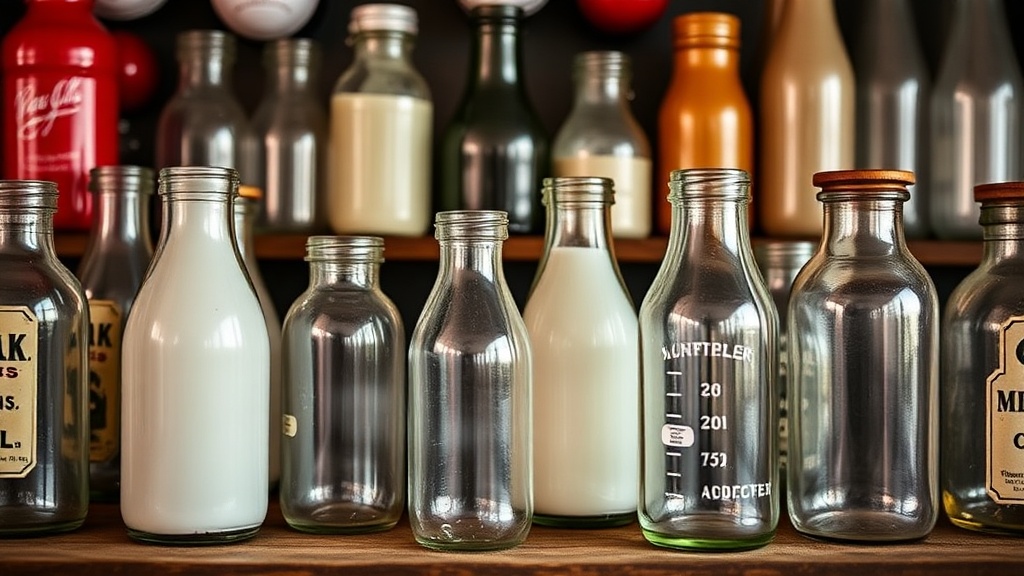
5 Vintage Milk Bottles Every Collector Dreams of Finding

Amber and Cobalt Blue Dairy Bottles
Embossed Squat Pints from Regional Dairies
Cream Top Bottles with Separate Neck Bulbs
Milk Bottles with Original Metal Caps
Prohibition-Era Medicinal Milk Bottles
Every collector knows the rush of spotting something rare at a flea market or estate sale. This post covers five vintage milk bottles that represent the holy grail of dairy collecting—bottles so scarce, so historically significant, that finding one could transform a collection overnight. These aren't just old glass containers. They're artifacts of American dairy history, advertising art, and industrial design rolled into one.
What Makes a Milk Bottle Valuable to Collectors?
Rarity drives value—but it's not the only factor. Condition matters enormously. A bottle with its original paper label, vibrant pyroglaze (painted) design, or embossed logo commands premium prices. Provenance helps too. Bottles from defunct dairies, limited production runs, or specific geographic regions attract serious buyers.
The catch? Condition is everything. A cracked bottle drops to near-worthless. Chips, especially on the lip or base, slash value by 50% or more. Collectors pay top dollar for mint-condition specimens with no clouding, no sickness (that milky haze collectors hate), and original closures intact.
Here's the thing about the bottles on this list: most collectors will never own one. But knowing what to look for? That knowledge separates casual hobbyists from serious collectors. Spotting a sleeper at a garage sale—that's the dream.
1. The Thatcher's Common Sense Milk Jar
Harvey D. Thatcher patented his "Common Sense" milk jar in 1886, revolutionizing home milk delivery. These quart-sized glass jars with wire-bail closures and porcelain lids represent the bridge between open pails and modern bottles. Finding one with an intact porcelain lid and original wire? That's a four-figure bottle.
Thatcher jars feature distinctive embossed lettering reading "Thatcher's Common Sense Milk Jar" around the shoulder. The porcelain lids came in various colors—white, blue, cream—and surviving examples with undamaged lids are museum-grade pieces. Most were produced in the Northeast, particularly New York and Pennsylvania, though the design spread nationwide.
Collectors hunt for variations: different lid manufacturers, embossed vs. smooth bases, and pint versus quart sizes. The pint versions fetch higher prices due to scarcity. A Thatcher jar with original advertising from a specific dairy—say, Borden or a local creamery—adds significant premium.
Worth noting: Reproductions exist. Check the glass quality—originals have slight bubbles and imperfections. Modern reproductions feel too perfect, too uniform. The embossed lettering on fakes lacks the crisp depth of 19th-century mold work.
2. The Amber Clorox Bottle Variants
Wait—Clorox? Yes. During the 1920s and 1930s, some dairies experimented with amber glass bottles, believing the darker color better protected milk from light degradation. These experiments failed commercially (consumers preferred clear glass), making surviving examples extraordinarily rare.
The amber bottles most coveted by collectors come from specific dairies: Borden's, Shelburne Farms (Vermont), and select California creameries. They're not truly Clorox bottles—that's collector slang referencing the similar amber glass. True dairy amber bottles have milk-specific shapes: the classic "milk bottle" silhouette with narrow neck and wide body.
Condition challenges abound. Amber glass shows scratches more visibly than clear. Many surviving examples suffer from "sickness"—that irreversible clouding caused by minerals leaching from the glass over decades. A clear, sparkling amber milk bottle with crisp embossing represents a true trophy piece.
Pricing varies wildly based on dairy and condition. Generic amber bottles might fetch $200-400. Named examples from prestigious dairies? $1,500 to $3,000 isn't uncommon at auction. The Federation of Historical Bottle Collectors tracks recent sales if you want current market data.
Which Milk Bottle Brands Are Most Sought After?
Borden, Hood, and Shelburne Farms dominate high-end collections—but regional dairies often surprise. Collectors pay premiums for bottles from defunct creameries with limited production runs. A bottle from a dairy that operated only five years beats a generic Borden from 1950 every time.
Here's a breakdown of what drives desirability:
| Factor | Impact on Value | Examples |
|---|---|---|
| Embossed Logo | High—adds 30-50% | Borden's Elsie, Hood's "H" logo |
| Pyroglaze Design | Very High—can double value | Full-color dairy scenes, children's motifs |
| Regional Scarcity | Extreme—10x multiplier possible | Single-town dairies, short-lived operations |
| Closure Type | Moderate | Original caps, porcelain lids, wire bails |
| Size | Variable | Pint (rarer), half-pint, quart, half-gallon |
That said, brand recognition only goes so far. A beat-up Borden bottle won't outprice a pristine example from obscure "Maple Leaf Dairy, Ottumwa, Iowa." Collectors eventually learn: scarcity trumps fame.
3. The Baby Top Bottle
These squat, wide-mouthed bottles from the 1940s and 1950s were designed for—yes—babies. Dairies marketed them for infant feeding, with wide openings for easy cleaning and pouring. Their distinctive shape (short, almost spherical bodies) makes them instantly recognizable.
The holy grail of baby tops? Examples with original nipple rings and caps. These small metal or plastic components rarely survived, making complete specimens valuable. Gerber Baby Food actually licensed some variants, featuring the famous Gerber baby logo. Those command serious premiums.
Baby tops came in both clear and green glass (the green being rarer). Look for embossed ounces markings, dairy names, and patent numbers. Some collectors specialize exclusively in baby tops, creating intense competition for the best examples at shows like the Antique Bottle Show events held nationwide.
The thing about baby tops—they're oddly charming. Their proportions feel almost toy-like. That visual appeal drives prices beyond what scarcity alone would suggest. A perfect green glass baby top with original closure? Budget $800-1,200. The Gerber variants? Double that.
4. The Milk Can with Spout
Not technically a bottle, but these small metal cans with pour spouts represent transitional dairy technology from the 1910s-1930s. They typically held cream or specialty milk products, featuring screw-top lids and precise pouring mechanisms.
The most collectible examples bear lithographed labels with dairy names, pastoral scenes, or art deco designs. Unlike glass bottles, these cans corrode. Finding one with intact, readable labels and no rust holes? That's the challenge that keeps collectors hunting.
Cream cans from hotel chains (the Waldorf-Astoria had custom creamers), railroad dining cars, and ocean liners fetch top dollar. The transportation connection adds narrative value collectors love. A cream can from the Pennsylvania Railroad's dining service might sell for $400-600 despite being just a few inches tall.
Storage matters enormously with these. Once rust starts, it accelerates. Smart collectors keep cream cans in climate-controlled environments, away from humidity. Some apply conservation-grade waxes to slow oxidation—controversial among purists, but practical for preservation.
5. The Figural and Specialty Shapes
Here's where collecting gets weird—and wonderful. Throughout the 1930s-1950s, some dairies commissioned custom bottle shapes: babies, cows, fire hydrants (for a fire department charity promotion), even miniature log cabins. These figural bottles were marketing stunts, produced in tiny quantities.
The baby-shaped bottles are most common among figural varieties, but even those are scarce. Cow-shaped bottles from specific dairies—Borden naturally produced some—represent serious prizes. The log cabin bottles from Vermont creameries celebrate that state's architectural heritage.
Condition becomes complicated with figural bottles. Thin protrusions (ears, horns, chimneys) break easily. Paint decoration, when present, flakes. A perfect figural bottle with original paint intact might represent a once-in-a-decade find at any given bottle show.
Pricing figural bottles is nearly impossible—they're too rare for consistent markets. Value depends entirely on what two collectors at the same show will pay. Auction records show baby figural bottles from known dairies selling between $500-2,000. Cow shapes? $800-3,000 depending on dairy and condition. The truly exotic shapes (that fire hydrant)? Five figures aren't impossible.
Where Do Collectors Actually Find These Bottles?
Estate sales, barn cleanouts, and forgotten storage units yield the best discoveries. Antique shops price bottles at retail—sometimes above retail—eliminating the profit margin that makes collecting economically viable. The serious collectors arrive at estate sales early, flashlights in hand, ready to dig through boxes of "old jars."
Online marketplaces have changed everything. eBay offers selection but also inflated prices and condition misrepresentation. Facebook collector groups provide education and occasional deals, though drama abounds. Dedicated bottle auction sites like American Bottle Auctions offer authenticated, graded specimens—for premium prices.
The reality? Most great finds happen accidentally. A homeowner cleaning Grandma's basement. A farmer knocking down an old outbuilding. Being known as "the bottle person" in your community generates tips. "Hey, my uncle has some old milk bottles"—that phone call changes everything.
How Should Beginners Start Collecting Milk Bottles?
Start local. Collect bottles from dairies that operated within 50 miles of home. This geographic focus provides manageable scope, historical connection, and hunting advantage—you'll spot local bottles others overlook. Regional collecting also builds expertise that transfers when you expand.
Buy the book before the bottle. "The Milk Bottle Book" by Roger Wilde and "Milk Bottles and Their Makers" by #Web are essential references. Learn to identify reproductions, common damage patterns, and fair pricing before spending serious money. The $30 book saves $300 mistakes.
Join the community. The Federation of Historical Bottle Collectors hosts annual shows where beginners handle thousands of bottles, learning glass quality and condition assessment through touch. Online forums provide 24/7 access to experts who'll authenticate questionable purchases.
Finally, collect what speaks to you. The pyroglaze advertising art. The embossing quality. The local history. The thrill of the hunt. Whatever drives your interest—follow it. The "best" collection isn't the most valuable. It's the one that brings you back to the hobby decade after decade, still hunting, still learning, still hoping today's the day you find that Thatcher jar with the perfect porcelain lid.