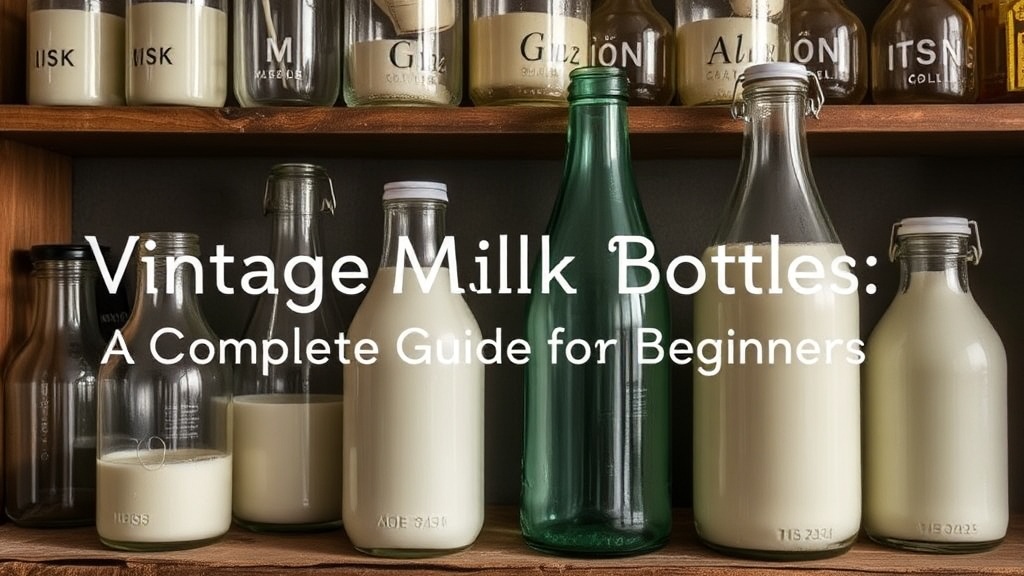
Collecting Vintage Milk Bottles: A Complete Guide for Beginners

What Will You Learn About Vintage Milk Bottle Collecting?
This guide covers everything needed to start a vintage milk bottle collection — from identifying valuable pieces and understanding manufacturer markings to proper cleaning, storage, and where to buy. Whether drawn to the colorful advertising, regional dairy history, or the tactile charm of old glass, you'll find practical steps to build a meaningful collection without overspending or buying fakes.
What Makes Vintage Milk Bottles Worth Collecting?
Vintage milk bottles represent one of the most accessible entry points into antique glass collecting. Unlike some hobbies requiring deep pockets, quality bottles often sell between $5 and $50, with rare specimens reaching into the hundreds. The appeal runs deeper than price tags — each bottle tells a story about local agriculture, advertising art, and American domestic life before cartons and plastic jugs took over.
Collectors typically focus on several categories. Embossed bottles feature raised lettering showing dairy names, locations, or slogans. Pyro-glazed (aka ACL or Applied Color Label) bottles display colorful painted designs that have survived decades. Picture bottles — shaped like cows, houses, or other figures — command premium prices. Embossed slugs (the round caps) and creamers round out most collections.
The hunt itself becomes addictive. Flea markets, estate sales, and eBay listings hide treasures waiting for educated eyes. Unlike stamps or coins with rigid grading systems, milk bottle collecting retains some wild-west quality — bargains still exist for those who know what to look for.
How Can You Identify and Date Milk Bottles?
Accurate identification separates valuable finds from common junk. Start with the base markings — those mysterious numbers and symbols stamped into the glass bottom. These reveal the manufacturer and approximate production date.
Major glass companies dominated milk bottle production. Thatcher Manufacturing (marked with a "T" inside a diamond) operated from 1902 through the 1950s. Hazel-Atlas Glass Company (often "H over A") produced bottles from 1902 to 1964. Owens-Illinois Glass Company (diamond with an "O" and "I") became the largest producer after 1929. Ball Brothers — yes, the canning jar company — also manufactured dairy bottles, particularly in the Midwest.
Here's what base numbers typically indicate:
| Marking | Manufacturer | Era | Notes |
|---|---|---|---|
| T inside diamond | Thatcher | 1902-1950s | Common in Northeast, high quality |
| H over A | Hazel-Atlas | 1902-1964 | Wide variety of styles |
| Diamond with O-I | Owens-Illinois | 1929+ | Two-digit date codes after 1940 |
| 3-4 digit numbers | Various | Varies | Usually mold or plant identifiers |
Dating bottles requires combining multiple clues. Machine-made bottles (uniform seams, no pontil marks) indicate post-1905 production. Smooth bases without tooling marks suggest earlier manufacture. Applied color labels (ACL) became common after 1933, replacing embossed designs as the preferred advertising method.
Pay attention to lip styles too. Thatcher Common Sense lips (the company tried standardizing milk bottle mouths) date from the 1920s-1940s. Screw-top lips appeared in the 1940s and dominated post-1950. Crowns or cap seats (for metal caps) help narrow down eras.
Understanding Bottle Types and Shapes
Not all milk bottles look alike. Quart rounds — the classic cylindrical shape — represent the most collected category. Square or "French square" bottles gained popularity in the 1940s-50s for space efficiency. Half-pints and pints fetch higher prices due to lower survival rates. Specialty bottles — creamers, buttermilk jars, ice cream containers — attract niche collectors willing to pay premiums.
The seal type matters for dating. Lightning closures (wire bail tops) dominated before 1920. Thatcher closures used a glass lid with metal bail — common from 1920-1940. Metal caps took over after World War II. Finding a bottle with its original closure significantly increases value.
Where Should Beginners Buy Vintage Milk Bottles?
New collectors face a paradox — you need knowledge to avoid fakes, but handling real bottles builds that knowledge. Start with affordable, common pieces rather than rare "unicorns" that attract forgers.
Flea markets and antique malls offer the best learning environment. You can examine bottles in person, feel the glass quality, and talk to dealers. Bring a magnifying glass and a copy of The Milk Bottle Book by Roger R. and Thersa R. Peters (the collector's bible). Expect to pay $10-30 for standard embossed quarts, $5-15 for common ACL bottles.
Estate sales in dairy regions — Wisconsin, New York, Pennsylvania — occasionally yield untouched collections sold at fair prices. Arrive early, but don't ignore the "junk" boxes — that's where overlooked gems hide.
eBay works for specific wants but requires caution. Search completed sold listings to establish fair market values. Avoid sellers using stock photos or vague descriptions like "old milk bottle." Request additional photos of base markings and damage. Check seller ratings — established bottle dealers like MilkBottleGuy or VintageDairyFinds build reputations on accurate descriptions.
Milk bottle shows — yes, they exist — gather serious collectors and dealers. The National Milk Producers Association maintains a calendar of regional events. Admission runs $5-10, but the education proves invaluable.
Here's the thing about pricing — condition drives value more than rarity alone. A common bottle in mint condition often beats a rare piece with chips or cracks. Learn to spot sick glass (irreversible clouding from dishwasher abuse), bruises (internal fractures), and lip chips (the most common damage).
How Do You Clean and Store Milk Bottles Properly?
Cleaning seems straightforward until you ruin a $200 bottle. Never use dishwashers — the heat and harsh detergents cause permanent clouding (sick glass). Never use abrasive scrubbers on painted ACL labels — you'll scrub off the very artwork that creates value.
For clear glass bottles, start with warm water and mild dish soap. Soak for 24-48 hours to loosen dirt. Use bottle brushes (available at homebrewing shops like Northern Brewer or MoreBeer) to reach interiors. For stubborn mineral deposits, white vinegar works safely — fill and soak for several days.
ACL (painted) bottles require gentler treatment. Soak in plain water only — no soap, which can lift paint. Avoid any scrubbing near the design. Some collectors accept slight interior clouding rather than risk damaging labels.
For embossed bottles with ground/polished pontils (early handmade pieces), avoid acids entirely. These bases remain porous and absorb cleaning solutions, causing future staining. Plain water and patience serve better.
Storage matters as much as cleaning. Display away from direct sunlight — UV fades ACL paint over decades. Maintain stable temperatures — attics and garages experience dangerous expansion/contraction cycles. Use wooden shelves rather than metal — wood dampens vibrations and doesn't conduct temperature shocks.
Consider acrylic display risers (available from Clear Solutions or AMACO) to improve bottles and prevent rolling. For serious collections, LED strip lighting inside cabinets showcases embossing without heat damage. Avoid halogen spots — they generate enough heat to crack cold glass.
Worth noting: original closures (caps, lids, bails) add significant value. Store these separately in labeled bags — acids from old rubber gaskets can etch glass over time. Never force a stuck cap — try soaking in mineral oil for weeks rather than risking a broken neck.
What Are the Most Valuable Milk Bottles to Watch For?
Certain categories consistently command premium prices. Picture bottles — shaped like cows, houses, teepees, or busts — start around $100 and reach into thousands for rare designs. The Borden's Elsie the Cow bottles represent the most recognizable picture bottle, with early versions bringing $75-300 depending on condition.
Prototype or sample bottles — test runs from glass factories — rarely surface but create bidding wars when they do. Embossed bottles from defunct dairies in small towns attract local historians. Errors and oddities — double-struck embossing, off-center labels, wrong colors — fascinate specialized collectors.
Geographic desirability plays a huge role. Bottles from Western states (scarcer population, fewer surviving dairies) typically outprice Eastern equivalents. Hawaiian dairy bottles — from the Royal Hawaiian Dairy or similar — start at $200. Alaska bottles command even more due to extreme rarity.
Early hand-blown milk bottles (pre-1900) appear crude by modern standards — uneven walls, bubbles, off-center necks — but scarcity drives prices. These rarely carry dairy names, making attribution difficult without experience.
The catch? Condition thresholds become stricter as prices rise. A $10 bottle with a small chip remains a $10 bottle. A $500 bottle with the same chip might become a $50 bottle. Professional collectors often own multiple examples — a "display grade" piece and a "study grade" example for handling.
Start with what appeals aesthetically. Collecting solely for investment rarely brings joy — and milk bottles, unlike gold coins, don't reliably appreciate. Build knowledge, buy what you love, and let value take care of itself.