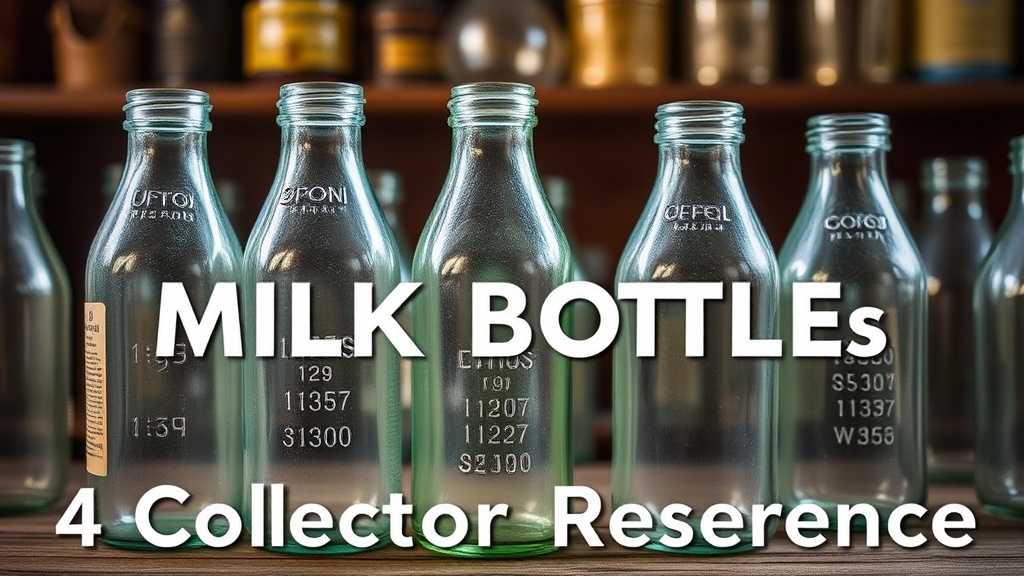
Decoding Vintage Milk Bottle Dates: A Collector's Reference

What Clues Does Glass Provide for Dating Milk Bottles?
Understanding the production timeline of your vintage milk bottles significantly enhances your collection's story and value. This guide will walk you through the precise methods collectors employ to date these fascinating artifacts, from scrutinizing glass characteristics to analyzing closure types and historical context. You'll learn to pinpoint the approximate era—and sometimes even the specific decade—when your bottle held its daily dairy delivery.
Examining Mold Seams and Manufacturing Marks
One of the most straightforward indicators of a milk bottle's age lies in its manufacturing process, specifically visible mold seams and base marks. Early hand-blown bottles, pre-dating the 1890s, often exhibit a pontil mark on the base—a rough, often circular scar left where the glassblower's rod was attached. As manufacturing evolved towards semi-automatic and then fully automatic bottle machines, these marks disappeared. Instead, you'll find mold seams. Look for seams that extend only partway up the body or stop at the neck, indicating a two-piece or three-piece mold used in earlier machine production (roughly 1890s-1910s). Bottles with seams running all the way to the top lip, covering the entire height, generally signify fully automatic machine production, a standard after 1917 with machines like the Owens Automatic Bottle Machine becoming widespread. The uniformity and crispness of these seams also offer clues; older machine-made bottles might have less precise seams than their later counterparts.
Interpreting Glass Clarity, Bubbles, and Color Shifts
The very composition and appearance of the glass itself can betray a bottle's age. Older bottles, particularly those from the late 19th and early 20th centuries, often contain more imperfections—tiny air bubbles, swirls, or inconsistent thickness—a byproduct of less refined manufacturing processes. Modern glass, by contrast, tends to be remarkably clear and free of such flaws. Another fascinating dating cue is solarization. Glass from certain periods, particularly 1880s to the 1920s, contained manganese as a decolorizing agent. When exposed to ultraviolet light (like sunlight) over many decades, this manganese oxidizes, causing the glass to slowly turn amethyst or a light purple hue. If your clear bottle has a subtle purple tint, it’s a strong indication of this specific manufacturing period. Later decolorizers, like selenium, would turn glass straw yellow or amber if solarized, though this is less common in milk bottles.
You can learn more about glass manufacturing history from a reputable source like the