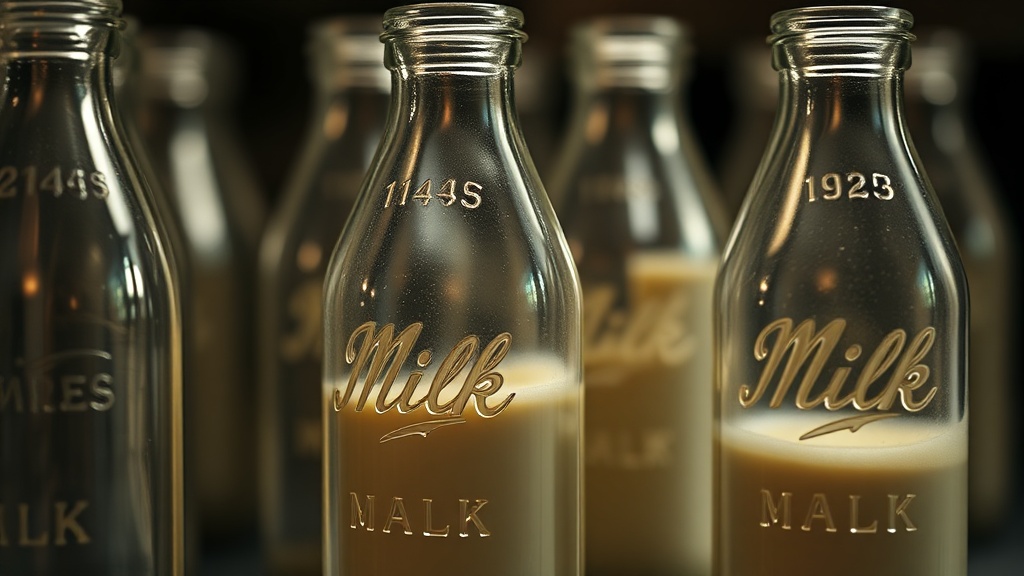
Reading the Glass: What Embossed Milk Bottles Reveal About American Dairies

A Flea Market Discovery That Raises Questions
You're rummaging through a cardboard box at a Midwest estate sale—dust motes dancing in the morning light—when your fingers brush against cold, heavy glass. You pull out a quart milk bottle, its surface raised with the name "Rosenberg Dairy" in bold serif lettering, a small cow silhouette etched beneath. The glass has that subtle purple tint that hints at age, and the base shows a distinct mark that looks like a number inside a diamond. The seller wants eight dollars. Is this a common find from the 1950s, or something older—maybe something worth documenting?
Embossed milk bottles carry stories pressed directly into their glass. Unlike paper labels that disintegrated decades ago or painted logos that faded under scrubbing, raised lettering survives generations of washing, filling, and storage. For collectors, these bottles represent a tangible connection to local food systems that vanished long before anyone coined the term "farm-to-table." Each embossing pattern, mold seam, and base marking offers clues—not just about the bottle itself, but about the dairy that commissioned it and the era when regional bottling plants dotted every county in America.
How Can You Tell When an Embossed Milk Bottle Was Made?
Dating embossed milk bottles requires attention to manufacturing details that changed systematically over decades. The most reliable indicator sits right at the shoulder—where the neck meets the body. Bottles made before 1900 typically show a "applied lip," where the top was added separately from the body, leaving a visible seam or ring where the two pieces joined. Hold the bottle sideways and examine that junction carefully—an uneven, almost hand-worked appearance suggests pre-automation production.
Machine-made bottles dominated after 1903 when Michael Owens patented his automatic bottle machine, but adoption spread slowly across the dairy industry. By the 1920s, most embossed milk bottles showed smooth, uniform seams running vertically from base to lip—the telltale signature of machine production. These bottles also feel lighter than their hand-blown predecessors, with thinner, more consistent walls. The base markings changed too—earlier bottles often carried simple numbers or symbols indicating the glass factory, while post-1920 examples frequently include full company names, patent dates, or even model numbers.
The glass itself provides chronological hints. That lavender or amethyst tint you noticed? It's not intentional coloring—it's a chemical reaction. Manganese dioxide, commonly used as a clarifying agent in glass production between the 1880s and 1915, slowly turns purple when exposed to ultraviolet light over decades. Clear bottles from this period that were stored in dark basements remained colorless, while their sun-exposed counterparts developed that distinctive grape-like hue. If your bottle shows even coloring throughout without the telltale "sun purple" gradient, it likely dates to after 1915 when selenium replaced manganese in most American glasshouses.
What Do Dairy Embossings Tell Us About Regional History?
The specific wording and imagery embossed on milk bottles opens windows into local agricultural history that no textbook captures. A bottle reading "Certified Raw Milk" places itself in the 1920s-1930s, when progressive health movements demanded stricter dairy standards before pasteurization became universal. The phrase "Grade A" appeared widely after 1923, when the U.S. Public Health Service standardized milk grading systems that varied wildly between states and cities.
Small family dairies often commissioned custom embossings that included their street address, phone number (sometimes just three or four digits in rural areas), or slogans like "From Contented Cows" or "Better Babies Drink Our Milk." These marketing messages reflect the competitive landscape of pre-supermarket America, when dozens of dairies might serve a single city and brand loyalty meant everything. The Society for Historical Archaeology's bottle dating guide maintains extensive records of regional dairy markings that help collectors connect specific embossings to their geographic origins.
Some bottles carry particularly telling details. "Deposit" markings indicate the era before disposable containers, when bottles circulated between consumers and dairies for years. Specific ounce measurements—like "One Quart Liquid" versus "32 oz."—reflect shifting regulatory standards; the former dominated before 1950, while metric-influenced labeling appeared later. Even the typography matters—Art Deco lettering suggests the 1920s-1930s, while streamlined sans-serif fonts point to post-WWII production.
Why Did Some Dairies Use Generic Bottles?
Not every embossed bottle bore a dairy name. Glass manufacturers produced "stock" bottles with generic designs—simple horizontal ridges, vertical fluting, or unmarked surfaces meant for dairies that couldn't afford custom molds. These bottles typically carried paper labels that identified the specific dairy, making them less collectible today but historically significant as evidence of smaller operations with limited capital. The presence of a dairy-specific embossing often indicates a substantial, established business—one confident enough to invest hundreds of dollars in custom mold production (roughly equivalent to several thousand in today's currency).
How Should You Document and Research Your Embossed Finds?
Building a meaningful collection requires more than accumulation—it demands documentation. When you acquire an embossed bottle, photograph it immediately against a neutral background, capturing the full embossing clearly. Record every marking on the base and heel (the curved area just above the base), even if they seem meaningless—a "7" inside a circle might identify the specific mold cavity at a factory, helping researchers match bottles to production runs.
The Federation of Historical Bottle Collectors maintains regional databases where members share findings and collaborate on identification. Many collectors specialize by geography—one might focus solely on Wisconsin dairies, another on bottles from defunct Los Angeles creameries. This specialization allows for deeper research, including cross-referencing city directories, Sanborn fire insurance maps, and dairy industry publications to establish when specific operations existed and what bottle styles they used.
Condition matters significantly for embossed bottles, but not always in obvious ways. Chips and cracks obviously reduce value, but some wear tells authentic stories. A bottle showing consistent base wear—what collectors call "table ring"—likely served actively in dairy circulation for years. Milk staining inside the neck that resists cleaning suggests genuine use rather than reproduction. However, watch for "sick glass"—a cloudy, permanently etched interior caused by decades of milk protein decomposition. This damage cannot be reversed and substantially reduces both display appeal and monetary value.
Where Can You Find Reliable Price Information?
The embossed bottle market varies tremendously by region, rarity, and condition. Common quart bottles from major cities might sell for $15-30 at auction, while rare embossed examples from small-town dairies—especially those that operated briefly during the 1920s-1940s—can command $200-500 from serious collectors. The Antique Bottles price guide offers updated market data, though prices fluctuate based on condition and provenance.
Provenance—documented ownership history—adds considerable value. A bottle with paperwork connecting it to a specific dairy family, or photographs showing it in historical context, carries premium significance. Some collectors maintain "dairy files"—research folders connecting their bottles to census records, newspaper advertisements, and city directory listings. This contextual documentation transforms a pretty glass object into a genuine historical artifact with stories attached.
The physical characteristics affecting value extend beyond condition. Color commands premiums—cornflower blue milk bottles (created by adding cobalt oxide) remain highly sought after, as do amber examples from the 1930s-1940s when some dairies requested tinted glass for light protection. Size matters too—pint bottles outnumber quants significantly, making half-pint and pint embossed examples proportionally more valuable. Even the closure type influences pricing—bottles designed for early metal caps, thumb stoppers, or wire bails each attract specialists who focus on specific closure technologies.
What Preservation Methods Protect Embossed Details?
Cleaning embossed bottles requires restraint. That raised lettering creates perfect crevices for dirt accumulation, but aggressive scrubbing with abrasive tools damages the glass surface and can wear down sharp embossing edges over time. Start with simple soaking—warm water with a drop of mild dish soap, left overnight to loosen organic residue. For stubborn interior staining, rice and water swirled gently can scrub without scratching (though never use sand or gravel, which leaves permanent marks).
Display choices affect longevity more than most collectors realize. Direct sunlight accelerates the manganese reaction in pre-1915 glass, potentially turning a light amethyst bottle dark purple—or even brown—in just a few years. While some collectors prize deep "sun purple" coloration, purists often prefer bottles that retained their original clear or aqua tint. UV-filtering glass or acrylic display cases offer protection without sacrificing visibility. Temperature fluctuations also stress old glass; avoid placing bottles near heating vents or exterior walls where seasonal expansion and contraction creates microscopic fractures that eventually become visible cracks.
Storage positioning matters for bottles with applied color labels or embossed designs. Never stack embossed bottles—the weight concentrates on raised lettering, creating pressure points that cause cracking or chipping. Individual shelving with support at the base (not the body) prevents stress. For particularly rare pieces, consider archival-quality foam rings that cradle the bottle without contacting the embossing directly. These small investments in preservation protect not just monetary value, but the historical information these bottles carry—the names of forgotten dairies, the marketing slogans of immigrant entrepreneurs, the physical evidence of how Americans fed their families before refrigeration changed everything.