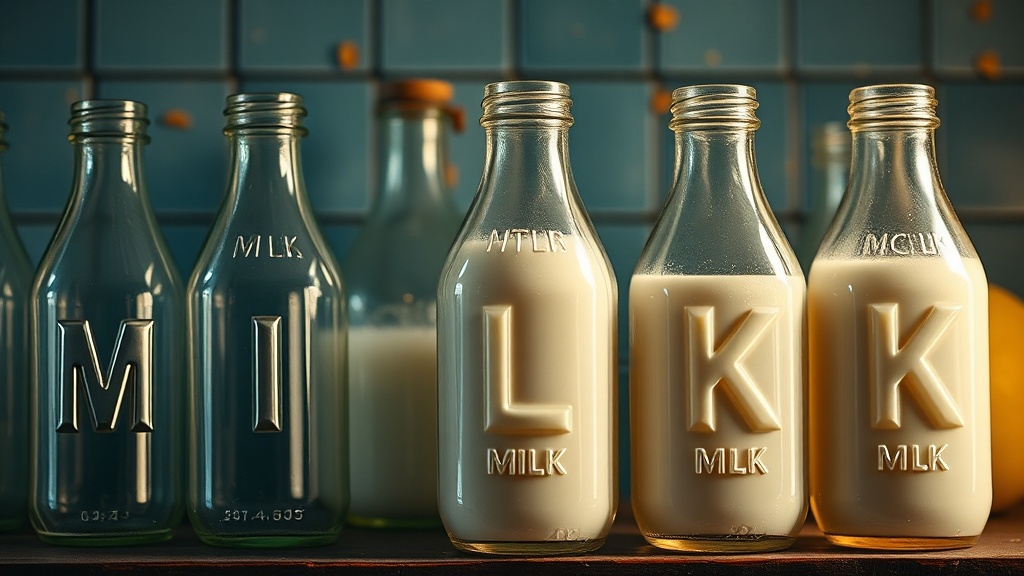
What Do the Raised Letters on Vintage Milk Bottles Actually Tell Us?

You’re at a flea market, sifting through a crate of dusty bottles, when you spot one with bold raised lettering spelling out “Maple Grove Dairy.” The glass has that soft, cloudy patina that only comes from decades of sitting in a barn. You turn it over, and there—at the base—are more markings: a number, maybe a symbol, and what looks like a manufacturer’s code. These embossed details aren’t just decorative flourishes added for charm. They’re a coded language—one that can tell you when the bottle was made, which glass factory produced it, and sometimes even the specific dairy that filled it.
Understanding bottle embossing transforms casual collecting into something far more rewarding. Those raised letters and numbers—technically called “embossed markings”—were functional tools in the dairy industry. They helped dairies claim ownership of their bottles (which were expensive and frequently stolen), allowed consumers to identify their preferred milk source, and enabled glass manufacturers to track their production runs. Today, they’re the primary way collectors date bottles, verify authenticity, and research the small-town dairies that once dotted the American landscape.
Why Did Dairies Emboss Their Names Directly Into the Glass?
Before the 1930s, milk bottles were valuable property. A single bottle might cost a dairy the equivalent of $15-$20 in today’s money, and competitors—or thrifty housewives—weren’t above “repurposing” them. Embossing a dairy’s name directly into the glass during manufacturing made theft harder and helped ensure bottles made their way back to their rightful owners.
The practice started in the 1880s when dairies began switching from bulk delivery in cans to individual bottles. Early bottles were hand-blown and often had paper labels, which washed off easily. By the 1910s, automatic bottle machines made embossed lettering practical at scale. A dairy could order custom molds with their name, logo, and even slogans cast directly into the glass. This wasn’t cheap—custom molds cost significantly more than generic ones—but dairies saw it as insurance against loss.
The style of embossing also signaled prestige. A dairy with ornate, multi-line embossing (“Oak Hill Farm—Pure Milk—Phone 234”) was advertising its modernity and professionalism. Smaller operations might settle for simple text or even just a number code. Today, these variations help collectors identify not just which dairy used a bottle, but often the size and sophistication of the operation itself. A bottle from a dairy that included a phone number in its embossing, for instance, narrows the dating window considerably—residential phone service became common in most American cities between 1900 and 1920.
What Do the Numbers and Symbols on the Base Mean?
Flip almost any vintage milk bottle over, and you’ll find a cluster of markings on the base. These can include numbers, letters, dots, dashes, and mysterious symbols that look like hieroglyphics to the uninitiated. They’re not random—they’re the signature of the glass factory that produced the bottle, and they’re invaluable for dating and authentication.
The most important mark is usually a number paired with a letter—something like “7 L” or “23 G.” This typically indicates the mold number and the plant location. Glass factories operated multiple molds simultaneously, and each needed identification so defective bottles could be traced back to their source. The number identifies the specific mold; the letter often indicates which factory location produced it. The Society for Historical Archaeology maintains extensive databases of these manufacturer marks, and matching a base mark to a specific glass company can narrow a bottle’s manufacture date to within a few years.
You’ll also sometimes see what collectors call “post-mold” marks—numbers or letters that were added after the bottle was formed, while the glass was still hot. These were often date codes or production batch identifiers. A “42” scratched into the base might mean 1942. A series of dots arranged in a pattern could indicate the quarter of the year. Each glass company had its own system, and learning to read these codes takes research. Collectors Weekly hosts community discussions where members share discoveries about obscure markings, and these crowdsourced efforts have decoded many previously mysterious symbols.
Some marks served technical purposes during manufacturing. A small raised circle or dot might indicate where the “ejection pin” pushed the finished bottle out of the mold. A diagonal line across the base could show where the mold halves met. These “mold seam” marks help collectors identify which manufacturing process was used—and that, in turn, helps date the bottle. Automatic bottle machines left different seam patterns than earlier hand-blown or semi-automatic methods.
How Can You Tell If Embossing Is Original or a Reproduction?
Reproduction milk bottles have flooded the market over the past two decades, and they’re getting harder to spot. Some are honest reproductions sold as decorative items; others are outright fakes designed to deceive collectors. The embossing is usually where fakes reveal themselves—if you know what to look for.
Original embossing from the early 20th century has specific characteristics. The edges of raised letters should be crisp but not perfect—hand-finished molds left slight irregularities. The depth of the embossing should be consistent with the bottle’s age; pre-1920 bottles often have deeper, more pronounced lettering because glass was thicker and molds were designed to impress deeply. The glass itself should show signs of age: a soft patina, minor surface wear, and (in many cases) the purple or amber tint that comes from decades of sun exposure to manganese-based glass.
Reproduction embossing often looks “too good”—perfectly uniform, mechanically precise, with no variation in depth or texture. The letters might feel sharp or brittle rather than smoothly integrated into the glass surface. Modern manufacturing can replicate old designs, but it struggles to replicate the subtle imperfections of hand-tooled molds. Additionally, reproductions often use glass formulas that don’t age the same way as vintage bottles. They might be too clear, too heavy, or show bubbles and striations that differ from period-appropriate glass.
One reliable test is the “feel” of the embossing under your fingertips. Original embossing was created when molten glass was forced into a mold; the glass and the raised design are one continuous piece. Run your finger across genuine vintage embossing, and you’ll notice smooth transitions—the raised letters flow naturally from the surrounding glass. Poor reproductions sometimes have embossing that feels “applied” or sits on top of the surface rather than rising from it. The difference is subtle but real, and experienced collectors develop an almost intuitive sense for it after handling enough authentic pieces.
Which Embossed Details Add the Most Value to a Bottle?
Not all embossing is created equal in the eyes of collectors. While any clearly marked dairy bottle has interest, certain types of embossed details command premium prices—and others can actually reduce value if they indicate commonness or damage.
Bottles with “full slug plate” embossing are among the most sought-after. A slug plate was a removable insert in the mold that allowed dairies to change their marking without ordering entirely new molds. These plates often featured elaborate designs: dairy barns, cows, milkmaids, or ornate scrollwork surrounding the dairy name. Because slug plates could be swapped out, they allowed for seasonal or promotional designs that are now rare collectibles. A Christmas-themed slug plate from a 1920s dairy, for instance, might be worth ten times more than the same dairy’s standard bottle.
Location-specific embossing also adds value. Bottles that name a specific city or town—“Riverside Dairy, Peoria, Ill.”—are more collectible than generic “Dairy” bottles because they can be tied to documented history. Collectors often specialize in bottles from specific states or regions, creating competitive markets for certain geographic markings. A bottle from a defunct dairy in a major city (Chicago, New York, San Francisco) will typically outsell a similar bottle from an unknown small town—unless that small town had only one dairy and few surviving bottles.
Finally, watch for “errors” in embossing. Mold-makers were human, and mistakes happened: misspelled dairy names, backward letters, mismatched dates. These error bottles were usually caught and destroyed, making survivors exceptionally rare. A bottle with an obvious embossing error—say, “Millk” instead of “Milk”—can be worth hundreds of dollars to the right collector. The key, of course, is authenticating that the error is original to manufacture and not damage or a modern fabrication. The National Milk Producers Federation archives historical dairy records that can sometimes verify whether a particularly unusual embossing variant is documented.
Learning to read bottle embossing takes time, reference books, and hands-on experience. But the reward is worth the effort. A bottle that looks like a generic piece of old glass becomes, with knowledge, a tangible connection to a specific dairy, a specific glass factory, and a specific moment in American food history. The raised letters aren’t just decoration—they’re a story written in glass, waiting for someone patient enough to decode them.